

How to Read Cricket Match Stats Before a Big Game
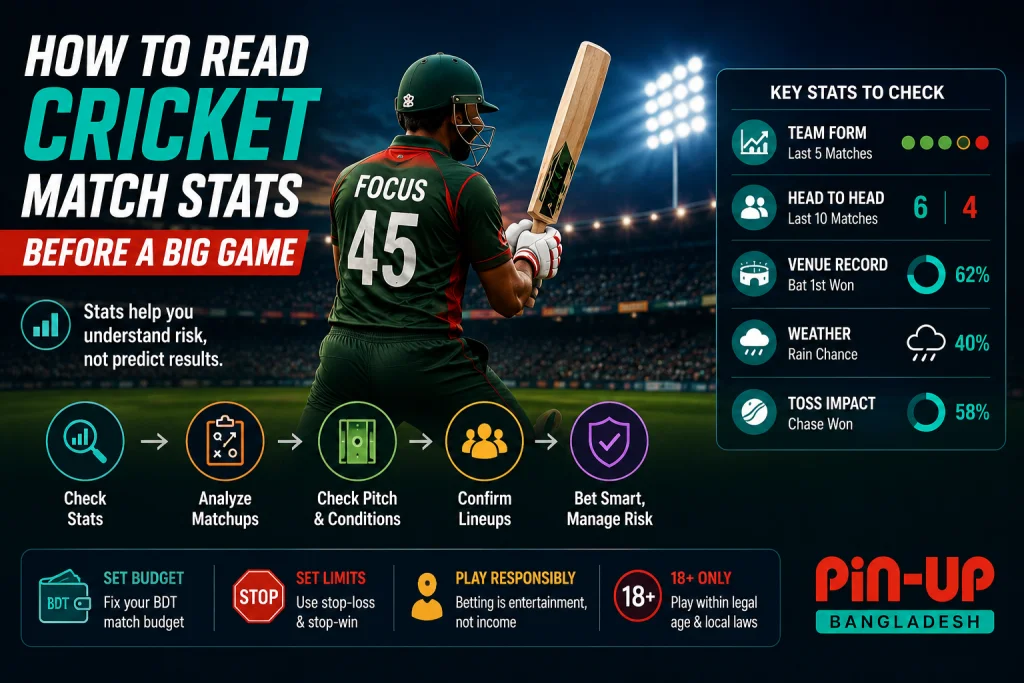
How to Read Cricket Match Stats Before a Big Game at Pin Up Bangladesh is an informational blog guide for cricket fans in Bangladesh who want to compare form, pitch, toss, and odds checks before a high-interest match while keeping any BDT decision cautious and budgeted. Stats help explain risk; they do not guarantee a result.
Cricket numbers can be useful only when they are read with context. A batter’s average, a bowler’s economy rate, or a team’s recent winning streak may look strong, but the format, venue, toss, weather, squad news, and match rules can change the meaning of every statistic.
Start With the Match Format First
The match format decides which stats matter most. T20, ODI, and Test cricket reward different skills, so one set of numbers should not be used for every game.
In T20 cricket, strike rate, death-over bowling, dot-ball pressure, and boundary control often matter more than long-term averages. In ODIs, middle-over stability, wicket preservation, and chasing history become more useful. In Tests, batting time, bowling spells, pitch deterioration, and session-by-session control carry more weight.
| Match format | Stats to check first | Why it matters before a big game |
|---|---|---|
| T20 | Strike rate, economy rate, powerplay record, death overs | Short matches can change quickly after one over |
| ODI | Average, middle-over scoring, wicket loss pattern, chasing record | Teams must balance run rate with batting depth |
| Test | Recent red-ball form, bowling workload, venue record, session control | Conditions and patience matter over several days |
Read Recent Form, But Do Not Trust It Blindly
Recent form is useful only when the opposition and format are similar. A team that won three T20s on flat pitches may not carry the same advantage into an ODI on a slower surface.
Before a big match, check whether the recent wins came against strong teams, weakened squads, or unfamiliar conditions. A 70-run innings in a low-scoring chase may be more valuable than a 90-run innings on a batting-friendly ground. The same logic applies to bowlers: a low economy rate is stronger when it comes against top-order batters, not just lower-order hitters.
Use this quick form checklist:
- Check the last 5–10 matches in the same format.
- Separate home, away, and neutral venue results.
- Look at who the team defeated, not only the result.
- Check whether key players were rested or injured.
- Compare performance while batting first and chasing.
Understand Batting Stats Before Comparing Players
Batting stats show scoring style, not just quality. A high average suggests consistency, but strike rate, boundary percentage, and dismissal pattern show whether the batter suits the match situation.
For Bangladesh cricket fans, this is especially important in T20 and ODI matches. A batter who scores steadily may be valuable in a chase, while a high-risk hitter may be more useful on a flat pitch with a short boundary. Neither profile is automatically better; the correct reading depends on the role.
| Batting stat | What it tells you | What to check before trusting it |
|---|---|---|
| Average | How often a batter converts innings into runs | Whether the sample is recent and format-specific |
| Strike rate | How quickly a batter scores | Whether it was built against strong bowling attacks |
| Boundary rate | Ability to hit fours and sixes | Ground size, pitch pace, and bowling matchups |
| Dot-ball percentage | Pressure created by non-scoring balls | Whether the batter starts slowly or struggles against spin/pace |
| Dismissal pattern | Common weakness | Whether the opponent has bowlers who target that weakness |
Read Bowling Stats by Match Phase
Bowling stats are strongest when split by phase. A bowler can be excellent in the powerplay but expensive at the death, or economical in the middle overs but less effective with the new ball.
For T20 betting analysis or pre-match comparison, economy rate alone can mislead. A death bowler may concede more runs because the hardest overs are assigned to them. A spinner may look strong in the middle overs but become less useful if dew makes the ball harder to grip.
| Bowling phase | Key stats | Practical reading |
|---|---|---|
| Powerplay | Wickets, economy, swing/seam impact | Early wickets can change the match tempo |
| Middle overs | Dot balls, spin control, partnership breaks | Pressure can force risky shots later |
| Death overs | Yorker accuracy, economy, boundary prevention | One poor over can change a T20 result |
| Long spells | Workload, consistency, injury risk | More relevant in Tests and ODIs |
Check Venue, Pitch, and Ground Conditions
Venue stats matter because the same team can perform differently on different surfaces. A ground with short boundaries may help boundary hitters, while a slower pitch can support spinners and cutters.
Do not read venue averages as fixed predictions. A pitch can change by season, weather, soil preparation, and match timing. In day-night games, dew can affect grip and fielding. On used surfaces, spin or uneven bounce may become more relevant. For a big match, recent matches at the same venue are usually more useful than old records from several years ago.
Useful venue checks include:
- Average first-innings score in the same format.
- Win rate for teams batting first or chasing.
- Spin versus pace wicket share.
- Boundary size and outfield speed.
- Weather and dew risk.
- Whether the pitch is fresh or previously used.
Toss and Weather Can Change the Stat Picture
Toss and weather can make pre-match stats less reliable. A team built for chasing may gain value after winning the toss, while rain can reduce overs and change the required scoring pattern.
The ICC explains the Duckworth Lewis Stern method as a way to calculate results and revised totals when weather interrupts a match and time is lost, so DLS risk should be part of any limited-overs match review.
Before a big game, check the toss result, expected rain windows, humidity, and match format. If the match is shortened, historical full-match averages may become less useful. In a 10-over chase, boundary hitting and wicket preservation mean something different than they do in a full 20-over innings.
Head-to-Head Records Need Current Squad Context
Head-to-head records are useful only when the teams and conditions are still comparable. A strong record from three years ago may mean little if the captains, bowlers, batting order, or venue have changed.
Use head-to-head data as a background signal, not as a final answer. It can show rivalry patterns, pressure moments, or repeated matchup problems, but it should be checked against current squad strength. A team that historically struggles against left-arm spin may still improve if new players handle that style better.
Compare Confirmed XIs Before Trusting Any Prediction
The confirmed XI is often more important than old averages. Cricket stats should be updated after team news because one missing opener, all-rounder, or death bowler can change the balance of the match.
Before reading odds or making a BDT decision, check whether both teams have announced their playing XI. Also check whether a player is returning from injury, workload management, travel, or poor form. A squad name on paper is not enough; the actual roles matter.
Important role checks:
- Who opens the batting?
- Who bowls in the powerplay?
- Who bowls the 18th, 19th, and 20th overs?
- Is there a reliable finisher?
- Is the wicketkeeper-batter in form?
- Does the team have enough spin or pace for the pitch?
Use Stats With the Bet Slip Carefully
Stats should help you reject weak bets, not force you into a bet. If Pin Up betting markets are visible in your current account environment, review every market rule before adding a selection to the bet slip.
Do not treat odds movement as proof that a result will happen. Odds can move because of team news, market volume, weather, toss, or temporary suspension. Live odds can change faster than the match situation you are watching on a stream or scorecard.
A safer bet-slip check looks like this:
- Confirm the match format and tournament rules.
- Check the playing XI, toss, pitch, and weather.
- Compare team and player stats in the same format.
- Open the market rules before selecting a bet.
- Check whether the bet is pre-match or live.
- Confirm the stake in BDT before submitting.
- Avoid increasing the stake because of emotion or crowd hype.
- Do not place the bet if legality, account access, or settlement rules are unclear.
Pre-Match Stats vs Live Match Stats
Pre-match stats explain preparation; live stats explain what is happening now. A smart cricket reader uses both, but does not confuse them.
| Stat type | Best use | Main risk |
|---|---|---|
| Pre-match form | Understanding team strength before the toss | Can become weaker after lineup changes |
| Venue record | Estimating pitch and scoring patterns | Old venue data may not match the current surface |
| Toss result | Updating chase or defend expectations | Toss advantage can be overstated |
| Live run rate | Reading current innings pressure | One over can distort the number |
| Required run rate | Understanding chase difficulty | Wickets in hand matter as much as the rate |
| Live odds | Seeing market reaction | Odds can suspend, move, or reject quickly |
Check Stats Sources and Live Panels
Use stats sources for research and the live platform panel for final rules. ESPNcricinfo Statsguru is presented as a cricket statistics query tool with filters across Tests, ODIs, T20Is, Twenty20 and other categories, which makes it useful for checking historical records and player/team filters.
However, historical stats do not replace live rules. If a market, bonus, cash-out option, or settlement condition appears inside Pin Up, confirm it in the current platform panel. Availability may depend on account status, region, device, platform settings, and live market conditions.
Mobile and App Safety for Cricket Stats
A separate cricket betting APK is usually not needed just to read match stats. Use verified sources for statistics and only use official Pin Up access points if they are available to you and permitted in your location.
Avoid third-party APK files that promise “fixed odds,” “sure tips,” or “VIP cricket predictions.” These can create serious risks, including phishing, malware, stolen login details, SMS code theft, and payment data theft.
Be cautious if an app asks for:
- SMS access;
- contacts access;
- accessibility permissions;
- overlay permissions;
- banking or payment app access;
- permission to read verification codes.
BDT Bankroll Checklist Before a Big Match
A BDT budget should be fixed before the match starts. Do not decide your stake after seeing hype, fan predictions, or fast odds movement.
Use this checklist before any real-money decision:
- Set a maximum match budget in BDT.
- Set a stop-loss before the first ball.
- Set a stop-win and leave when it is reached.
- Never use rent, food, family, education, or emergency money.
- Do not chase losses during live overs.
- Avoid betting when angry, tired, or under pressure.
- Keep stake size smaller for live betting because odds move quickly.
- Stop if you no longer understand the market or settlement rule.
Cashier and KYC Checks
Cashier details must be confirmed inside the live account, not assumed from general Bangladesh payment habits. Local bank or mobile wallet options should be treated as available only if they appear in the current cashier.
Before any deposit or withdrawal, check:
- account currency;
- available deposit methods;
- available withdrawal methods;
- minimum and maximum amounts;
- processing time;
- possible fees;
- name match between account and payment method;
- KYC requirements before withdrawal.
Verification may be required before a withdrawal. Use your real name and date of birth, keep payment accounts in your own name, prepare a government ID if requested, and upload documents only through official account tools. Do not edit documents, and stop depositing if a withdrawal is blocked for verification.
Bonus Terms for Cricket Betting
A cricket bonus should be checked before placing the bet, not after settlement. Bonus terms can vary by account, region, promotion, device, and current platform settings.
For betting bonuses, check:
- eligible sports and tournaments;
- minimum odds;
- single versus accumulator rules;
- number of selections required;
- expiry time;
- cash-out restrictions;
- maximum stake from bonus balance;
- maximum win cap if stated;
- void, cancelled, abandoned, or shortened match rules;
- whether live bets count.
If cricket or the specific market is not named in the terms, ask support through verified channels or avoid using the bonus for that bet.
Legal and Responsible Betting Notice for Bangladesh
Real-money betting access in Bangladesh must be treated cautiously. This blog page should not be read as a claim that online betting is legal, allowed, or available nationwide. Bangladesh’s Cyber Security Act 2026 includes a section on gambling in cyberspace, so users should check current law, platform access, account terms, and local restrictions before any transaction.
Cricket betting should be treated as entertainment, not income. Meet all age and local legal requirements, avoid “sure win” tips, do not chase live odds, and use cooling-off, deposit limits, or self-exclusion tools where available. Stats can reduce confusion, but they cannot remove risk.
Common Mistakes When Reading Cricket Match Stats
Most mistakes happen when users read one number without context. A high average, a winning streak, or a low economy rate can be misleading if the sample is small or conditions are different.
Avoid these errors:
- Comparing T20 stats with ODI or Test performance.
- Ignoring toss and weather.
- Treating head-to-head records as a prediction.
- Forgetting that DLS can change shortened matches.
- Reading old venue data without checking recent games.
- Trusting social media “fixed match” claims.
- Increasing the BDT stake after one successful bet.
- Using bonus money without checking market eligibility.
Example: Reading a T20 Match Without Making a Prediction
A practical cricket stats review should end with risk notes, not a guaranteed pick. Suppose Team A has stronger openers, but Team B has better death bowling. The venue has a fast outfield, yet rain is possible. Team A may look stronger before the toss, but a shortened chase could increase volatility.
A better reading would be:
- Team A has early batting strength.
- Team B may control the final overs better.
- Rain and DLS could reduce confidence in full-match stats.
- Toss may change chasing value.
- Any live market should be reviewed only after lineups and weather updates.
This method does not promise a result. It helps you understand what can go wrong before committing attention, time, or BDT.