

High Volatility vs Low Volatility Slots: What’s the Difference?
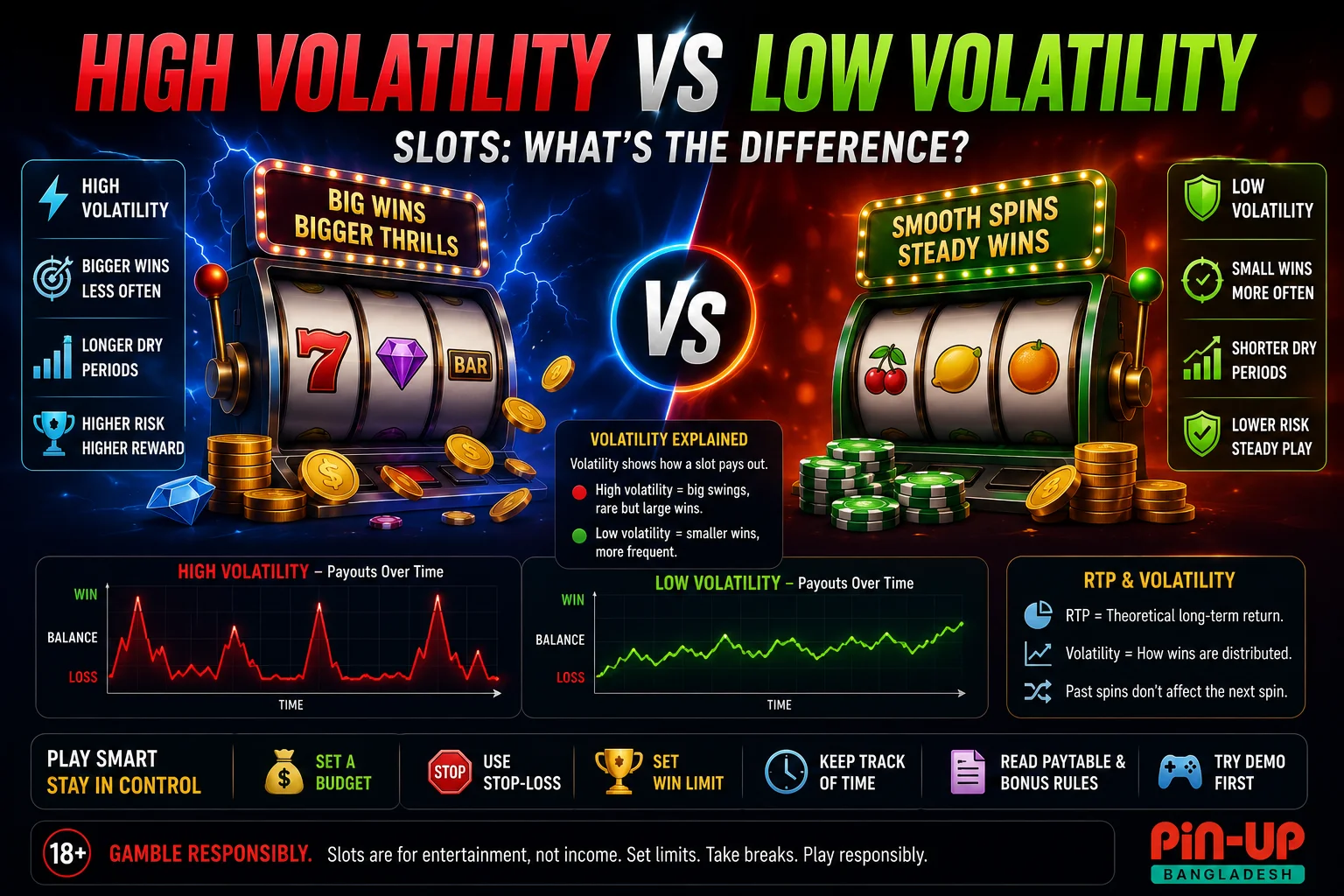
High Volatility vs Low Volatility Slots at Pin Up Bangladesh is an informational blog guide for Bangladesh users who want to understand payout rhythm, RTP, bankroll pressure, bonus checks, and BDT session planning before opening a slot. Volatility does not predict the next spin; it explains how uneven or steady a slot may feel.
The direct difference is simple: low volatility slots usually produce smaller wins more often, while high volatility slots may have longer dry periods and sharper payout swings. This does not make one type “better” or “safer.” It only means the game can affect your balance, patience, and risk differently.
Quick Answer: What Is Slot Volatility?
Slot volatility describes how payouts are distributed over time. A low-volatility game usually feels more stable because it may pay smaller amounts more frequently. A high-volatility game can feel more uneven because larger prizes may be rarer and gaps between wins can be longer.
The UK Gambling Commission explains volatility as commonly represented by standard deviation, with highly volatile games associated with “very large but rare” prizes and low-volatility games associated with “small and often” prizes. This is a general technical reference, not a claim about Pin Up licensing in Bangladesh.
| Slot type | Typical payout rhythm | Main user risk | Better first check |
|---|---|---|---|
| Low volatility | Smaller wins, more often | Feeling too comfortable and playing too long | Session time limit |
| Medium volatility | Mixed rhythm | Misreading balance swings | Stake size in BDT |
| High volatility | Longer gaps, sharper swings | Chasing a feature or big hit | Stop-loss before play |
| Very high volatility | Rare, heavy swings | Budget disappearing quickly | Demo mode and paytable |
High Volatility Slots Explained
High volatility slots are built for bigger swings. They may include large bonus features, multipliers, expanding mechanics, jackpot-style elements, or rare high-value symbol combinations.
The main issue is not that high volatility is “bad.” The issue is that it can test patience and budget control. A user with a small BDT session budget may run out of balance before seeing a feature. A user who keeps increasing the stake after losses can make the session much riskier.
High volatility may suit a user who:
- understands that long dry periods can happen;
- uses a fixed BDT session limit;
- does not chase free spins or bonus buys;
- accepts that the slot may end quickly;
- checks the paytable before playing;
- avoids using essential money.
High volatility may not suit a user who:
- wants a slower, steadier session;
- gets frustrated after many losing spins;
- increases stake size after losses;
- treats a near miss as a sign;
- uses a bonus without checking restrictions;
- has not read the feature rules.
Low Volatility Slots Explained
Low volatility slots are built for a smoother payout rhythm. They often create more frequent small wins, which can make the session feel slower and easier to follow.
The risk is different from high volatility. Low volatility can make users feel safer than they really are. Small wins may return part of the stake, but the total balance can still decline over time. A user may play longer, ignore time limits, or keep spinning because the game “feels active.”
Low volatility may suit a user who:
- wants to learn slot rules more calmly;
- prefers simpler mechanics;
- uses small BDT stakes;
- wants more time to read the game flow;
- avoids feature chasing;
- stops when the budget or time limit is reached.
Low volatility may not suit a user who:
- expects large payouts quickly;
- misunderstands small wins as profit;
- keeps playing because the balance moves slowly;
- ignores total session spend;
- assumes frequent wins mean low risk.
High vs Low Volatility: Practical Comparison
The practical difference is how the slot can pressure your bankroll. High volatility pressures patience and stop-loss discipline. Low volatility pressures time control and awareness of total spending.
| Question | High volatility slot | Low volatility slot |
|---|---|---|
| Are wins usually frequent? | Often less frequent | Often more frequent |
| Are wins usually large? | Potentially larger, but rarer | Usually smaller |
| Can the balance drop quickly? | Yes, especially with high stakes | Yes, but often more gradually |
| Is it beginner-friendly? | Usually harder for beginners | Often easier to learn |
| Does RTP guarantee a session result? | No | No |
| Is demo mode useful? | Yes, to understand long gaps and features | Yes, to understand payline rhythm |
| Main danger | Chasing bonuses or big wins | Playing too long because it feels steady |
RTP vs Volatility: They Are Not the Same
RTP and volatility explain different things. RTP is a theoretical long-term return model, while volatility explains the pattern of wins and losses.
A slot can have a relatively high theoretical RTP and still be highly volatile. That means the game may still produce long losing stretches in short sessions. A low-volatility slot can have a smoother rhythm but still reduce the balance if the user keeps spinning beyond the budget.
The UK Gambling Commission explains that actual RTP is calculated from wins and turnover, while theoretical RTP and volatility are calculated by designers and reviewed through external testing in that regulatory context. It also notes that small play volumes can have wide tolerance, which is why short sessions should not be treated as proof of the game’s long-term performance.
| Term | What it means | What it does not mean |
|---|---|---|
| RTP | Long-term theoretical return model | A promise for your session |
| Actual RTP | Measured result over recorded play | Proof of your next spin |
| Volatility | Payout swing and prize rhythm | A guarantee of win size |
| Hit frequency | How often a game may produce wins | Proof that wins are profitable |
| Max win | Upper possible win if stated | A realistic expectation |
Why Previous Spins Do Not Change the Next Spin
Past spins should not be used to predict the next spin. A slot is not “due” because it has not paid recently, and a recent win does not make the next round safer or more dangerous.
The UK Gambling Commission’s random-outcome standards say random number generation should be demonstrably random and unpredictable, with outcomes distributed according to expected or theoretical probabilities. The same standards state that adaptive behaviour, where probabilities are changed during play, is not permitted in that regulatory context.
Avoid these volatility myths:
- “High volatility means a big win is due.”
- “Low volatility means I cannot lose fast.”
- “A near miss means the bonus is close.”
- “Manual spins are better than autoplay.”
- “The slot pays more after midnight.”
- “Increasing the stake unlocks better outcomes.”
- “Demo results prove real-money results.”
How to Check Volatility in the Game Panel
The live game panel is the best place to check slot details. Availability, game rules, volatility labels, RTP information, demo mode, and bonus features can vary by provider, title, account, device, and current lobby settings.
Use this checklist before real play:
- Open the slot information panel.
- Check whether volatility is listed.
- Check whether RTP is listed.
- Read the paytable.
- Confirm paylines, ways, or cluster rules.
- Check minimum and maximum stake in BDT.
- Read free spin and bonus feature rules.
- Check whether bonus buy or gamble features exist.
- Test demo mode if available.
- Stop if the rules are unclear.
What If the Slot Does Not Show Volatility?
If volatility is not shown, do not guess it as a fact. Use softer signals and confirm through the live panel, provider information, or verified support if needed.
Possible clues include feature style, win frequency in demo mode, paytable structure, bonus type, and max win description if shown. These clues can help you understand the feel of the game, but they should not be written or treated as confirmed volatility unless the game panel or provider source states it.
| Signal | Possible meaning | Caution |
|---|---|---|
| Many small line wins | May feel lower volatility | Still can lose over time |
| Rare bonus trigger | May feel higher volatility | Demo is not proof |
| Large multipliers | May increase swinginess | Feature rules matter |
| Jackpot element | Often creates uneven outcomes | Jackpot availability can vary |
| Bonus buy | Can increase session risk | Bonus terms may restrict it |
| Complex grid mechanics | May feel swingy | Read rules before staking |
BDT Budgeting for High Volatility Slots
High volatility slots need a stricter BDT stop-loss. The main risk is spending too much while waiting for a feature or larger payout.
Use a smaller stake compared with your total balance. A session with too few possible spins can end before you understand the game. Do not add funds because the bonus “looks close.” Feature chasing is one of the easiest ways to lose control.
High volatility checklist:
- Set a fixed BDT session budget.
- Choose a stake that allows enough rounds.
- Set a stop-loss before the first spin.
- Set a stop-win and leave when reached.
- Avoid bonus buys while learning.
- Avoid autoplay if it speeds up losses.
- Do not chase scatters, multipliers, or free spins.
- Stop if frustration changes your stake size.
BDT Budgeting for Low Volatility Slots
Low volatility slots need a stricter time limit. The main risk is playing longer than planned because small wins keep the session feeling active.
A low-volatility slot can still drain a balance if the user keeps spinning. Track total session spend, not only the number of winning spins. A small win after a larger total stake is still a net loss.
Low volatility checklist:
- Set a BDT session budget.
- Set a clear time limit.
- Track total spend, not only win frequency.
- Avoid increasing stake because the game feels stable.
- Stop after the planned session ends.
- Do not assume frequent wins mean profit.
- Use demo mode to learn the rhythm first.
Which Volatility Type Should Beginners Choose?
Beginners usually understand low or medium volatility more easily. These games often give more visible feedback and may make it easier to learn paylines, wilds, scatters, and paytable rules.
High volatility slots can still be played carefully, but they require more discipline. The user must be comfortable with long gaps, quick balance swings, and the possibility that the session ends without a major feature.
| User situation | Better starting point | Why |
|---|---|---|
| Learning slots for the first time | Low volatility | Easier to observe rules |
| Small BDT budget | Low or medium volatility | More room to control stake size |
| Wants feature-heavy gameplay | Medium or high volatility | Features may be more complex |
| Gets frustrated quickly | Low volatility or no real play | Less pressure from dry stretches |
| Uses strict stop-loss | Any type with caution | Budget rules matter most |
| Does not understand paytable | Demo only | Real play should wait |
Bonus Terms: Volatility Can Affect Wagering Risk
A bonus can feel very different on high and low volatility slots. High volatility may create sharper balance swings during wagering. Low volatility may make wagering feel longer, but it does not remove risk.
Do not assume every slot contributes equally to a bonus. Current terms can vary by account, promotion, device, region, and platform settings.
Before using a slot bonus, check:
- eligible games;
- wagering contribution;
- maximum bet;
- expiry time;
- maximum win cap if stated;
- balance order;
- free spin value;
- bonus buy restrictions;
- gamble feature restrictions;
- jackpot restrictions;
- withdrawal conditions.
If a slot is not named as eligible, confirm through verified support channels or avoid using bonus funds on it.
Demo Mode: What It Can and Cannot Tell You
Demo mode can teach rules, but it cannot predict real-money results. Use it to check the paytable, feature rhythm, symbol rules, and whether the slot feels too fast or too swingy.
Demo mode can help you answer practical questions:
- Are the reels easy to follow?
- Are the paylines clear?
- How often do small wins appear?
- Is the bonus feature easy to understand?
- Does the game use cascades, multipliers, or buy features?
- Does autoplay make the session too fast?
- Does the game feel suitable for your BDT budget?
Demo mode cannot tell you that a real-money win is coming. It is a learning tool, not a forecasting tool.
Mobile and APK Safety
A separate volatility or slot APK is usually not needed. Use the verified Pin Up mobile site or official app source if available in your current environment and permitted in your location.
Avoid third-party APKs that promise “low-risk slots,” “high RTP mode,” “guaranteed bonus trigger,” or “volatility hack.” These claims are red flags because slot outcomes should not be predictable by an outside app.
Be cautious if an app asks for:
- SMS access;
- contacts access;
- accessibility permissions;
- overlay permissions;
- banking or payment app access;
- permission to read verification codes.
These permissions can expose users to phishing, malware, stolen login details, SMS code theft, and payment data theft.
Cashier and Payment Checks in BDT
Cashier details must be confirmed inside the live account. Do not assume that any payment method, limit, fee, or withdrawal time is available at Pin Up Bangladesh unless it appears in the current cashier.
Before depositing or withdrawing, check:
- Account currency.
- Deposit methods.
- Withdrawal methods.
- Minimum deposit.
- Minimum withdrawal.
- Processing time.
- Possible fees.
- Name match between account and payment method.
- Bonus balance restrictions.
- KYC requirements before withdrawal.
Use payment accounts in your own name. Stop depositing if a withdrawal is blocked for verification, and resolve the issue through official account tools before adding more funds.
KYC: Why Verification Matters After Slot Play
KYC can be required before withdrawal or account review. The exact flow can vary, so do not assume that a withdrawal will be instant after a slot win.
KYC checklist:
- Use your real name.
- Use your correct date of birth.
- Use payment accounts in your own name.
- Prepare a government ID if requested.
- Prepare proof of address if requested.
- Upload documents only through official account tools.
- Do not edit or modify documents.
- Do not send documents to unverified contacts.
- Stop depositing if verification blocks withdrawal.
- Contact support only through verified channels.
Responsible Gaming for Slot Volatility
Volatility should be treated as a risk-control signal, not as a winning strategy. High volatility can create emotional pressure through long gaps. Low volatility can create overconfidence through frequent small wins.
The Responsible Gambling Council advises users to plan before gambling, avoid chasing losses, avoid treating gambling as income, set time and spending budgets, use loss and win limits, take breaks, and step back if gambling stops feeling fun.
Use these rules before any slot session:
- Treat slots as entertainment, not income.
- Meet age and local legal requirements.
- Set a fixed BDT budget.
- Set a stop-loss.
- Set a stop-win.
- Set a time limit.
- Do not chase losses.
- Avoid feature chasing.
- Be careful with autoplay.
- Avoid bonus buys while learning.
- Take breaks.
- Use cooling-off, deposit limits, session reminders, or self-exclusion tools where available.
Legal Notice for Bangladesh
Real-money slot access in Bangladesh must be treated cautiously. This blog page should not be read as a claim that online casino play is legal, available, or allowed nationwide.
The official Bangladesh laws portal lists the Cyber Protection Act, 2026, dated April 10, 2026, and its table of contents includes Section 20 on gambling in cyberspace. Users should check current law, platform access, account terms, and local restrictions before any transaction.
Common Mistakes With Slot Volatility
Most volatility mistakes come from treating game rhythm as a prediction. A slow session does not mean a big win is close. A smooth session does not mean the game is safe.
Avoid these mistakes:
- Choosing high volatility with a very small BDT budget.
- Thinking low volatility cannot lose money.
- Treating RTP as a short-term return promise.
- Ignoring the paytable.
- Playing real money before checking demo mode.
- Chasing free spins after many losses.
- Using bonus funds without reading eligible game rules.
- Installing third-party APKs for “signals.”
- Increasing stake after frustration.
- Continuing after the stop-loss or time limit.
Final Takeaway
High volatility slots create bigger swings; low volatility slots create a steadier rhythm. High volatility can feel intense because larger features may be rarer. Low volatility can feel calmer because smaller wins may appear more often.
For Pin Up Bangladesh readers, the safer approach is to check the live game panel, read RTP and volatility if shown, test demo mode where available, choose a stake that fits a BDT budget, confirm bonus terms, and stop when the planned limit is reached.